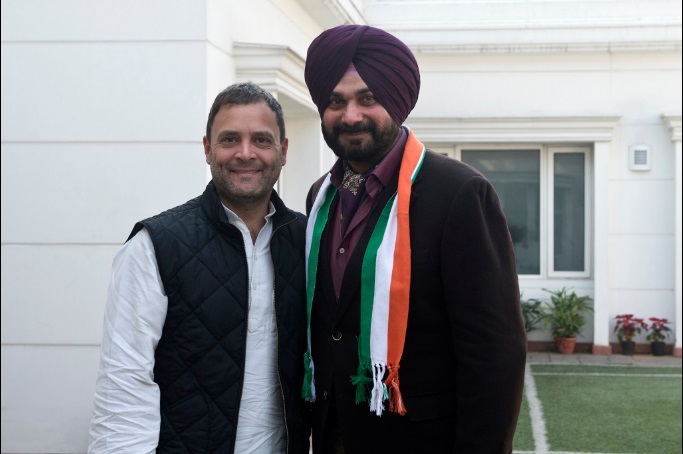

Blog 34 – Tennis’ Mental Giants: Unraveling the Psychology of Champions

Tennis is undoubtedly a rigorous sport that demands physical strength, agility, and discipline. However, just like there is no denying the importance of the mind-body connection in other arenas of life, the same holds true for the sport of tennis as well. The quickest, strongest player can easily be defeated on the court if they do not have the mental fortitude and resilience that competitive tennis demands. Let’s take a closer look at what tennis psychology entails.

Broadly referring to emotions, tactics, strategies, and motivations specific to the sport of tennis, tennis psychology is a sport-specific version of sport psychology that helps explain key mental aspects directly related to tennis as practiced by coaches and tennis players. Motivation is a critical component of the psychology of tennis. When you work on improving your enthusiasm and desire to excel, this is acutely reflected in your performance on the court as well. Regulating your emotions is also important when playing any sport, and tennis is no exception. It can be very easy to get frustrated, angry, or disappointed when losing consecutive points or sets, but it is vital to reign in your emotions and focus on the game ahead if you stand a chance of winning. Mental toughness, resilience, and stress have also been found to be interrelated markers that feature in competitive tennis players. For instance, a 2016 study among competitive South African tennis players found that mental toughness was positively related with resilience and negatively related with stress. This is due to a common pattern of effective coping strategies, adaptation, maintenance of performance, and commitment to achieve despite facing adversity. 

Tennis matches, and especially long rallies, require both physical and mental resilience and strength. It is without a doubt important to have stamina, flexibility, and agility to remain at the top of your game through a long set, but it is equally important to have mental toughness and resilience so you do not give up. Further, mental toughness is not only beneficial in adverse situations, but can also help propel you to the finish line during positive situations. Researcher Richard Cowen comments on his surprise at famous tennis player Andy Murray’s inability to capitalize on shifts in his favor such as breaking even, as well as his inability to maintain strong leads and follow through on his incredible serves. Mental toughness requires extensive self-control, self-discipline, and emotional regulation as these qualities help them remain unperturbed during stressful situations, while simultaneously providing them with the much-needed fuel required to follow through on positive breakthroughs. 
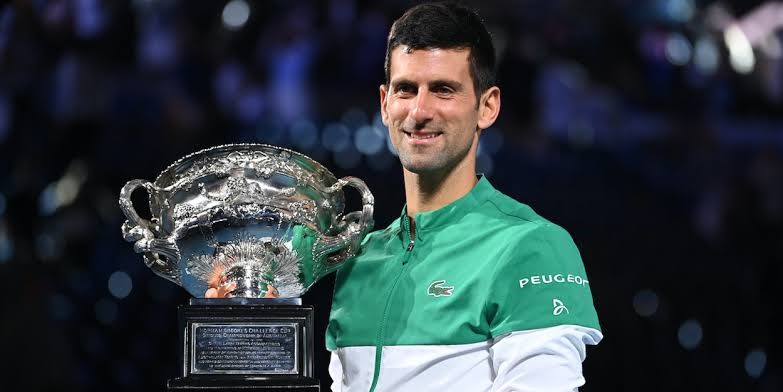
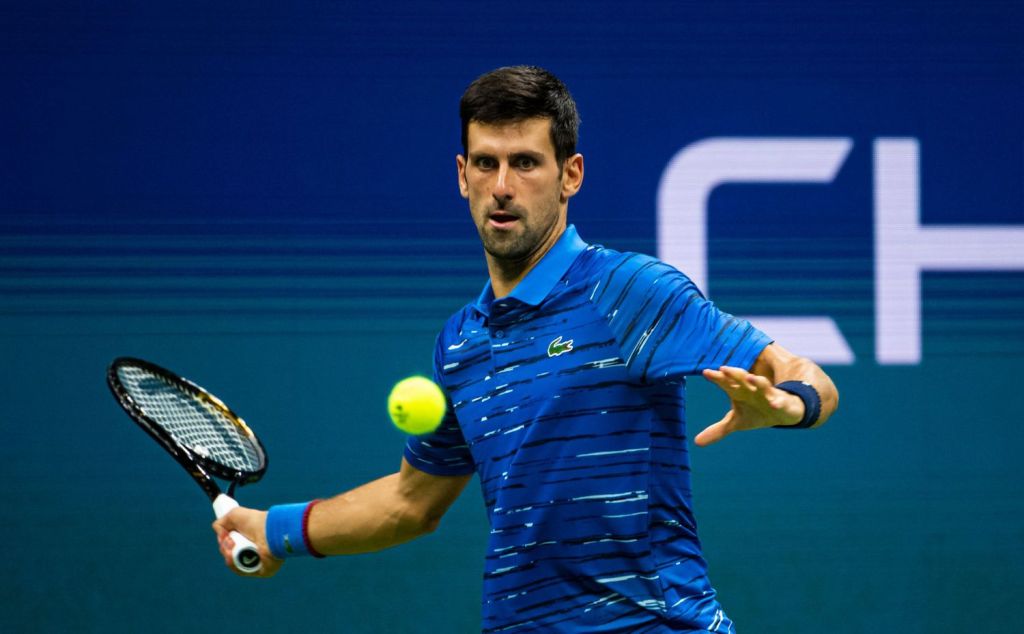
The Serbian tennis player, Novak Djokovic, who holds a record for winning 23 Grand Slams at the French Open, is a prime example of mental resilience and fortitude. Watching Djokovic return serves and consistently hold long rallies is like watching a work of art, and his fitness, technique, and dedication to the sport is unparalleled. The common thread between all these factors, as well as his consistent performance is his mental attitude towards the sport. He has openly advocated for mental training as part of his training routine, explaining the importance of incorporating 15 minutes of mindfulness exercises into his regimen every day. These exercises help him remain cognizant of the brain’s automatic response to trigger feelings of self-doubt in a negative situation, and they help him center himself and handle these emotions in an effective manner. There is no sport that allows for an error-free record, but by building greater resilience and fortifying your mental attitude, you can ensure that you adapt faster and more effectively to adversity, therefore ensuring that you always come out on top.

Sources:

  1. https://condorperformance.com/tennis-psychology/
  2. https://www.frontiersin.org/articles/10.3389/fpsyg.2016.00320/full 
  3. https://www.psychologytoday.com/us/blog/slightly-blighty/201509/do-tennis-champions-reveal-the-secret-mental-toughness 
  4. https://scroll.in/field/1051182/tennis-how-novak-djokovics-mental-strength-and-resilience-helped-him-set-a-new-grand-slam-record 

Blog 33 – “It takes one day”: India Vs Australia 2023 CWC Final

India ran a spirited campaign and played liked champions! 10 out of 10 wins in the run up to the finals! That too massive wins against many of the storied opponents. One of them was even against Australia, right in the opening encounter. And then the finals came up against Australia. A repeat of 2003 CWC final.

It takes one day! To play like champions on the final day. To become the champions.

Alas! It was not to be. The cookie crumbled the way it did for 10 reasons:

  1. Australia take a bold and contrarian call to field first – Known to set targets and seal the win in the first innings itself by posting mammoth totals, Australia went against one of their own cricketing mantras to restrict India to 241. They clearly saw something in the pitch that everyone else, even analysts and the Indian team did not see, as the general opinion was to bat first.
  2. Rohit gone early – After building the foundation of the innings, Rohit could’ve spent more time on the crease, even if it meant he had to play at a slower run rate. If he stuck there with Kohli for some more time, there would be no respite for the Aussies and the team could keep going at around 5-6 an over to build on the fiery start and be on track to set an unassailable total.
  3. Pitch had no turn to offer in the second innings – Even if we were to discount Head’s blatant attack, the pitch seemed to get better as the second innings progressed. There was nothing on offer for Jadeja and he seemed just a shadow of his usual self. While Kuldeep did bowl some googlies with around 50 runs to win, it was too little, too late.
  4. Head takes the attack to India – At 47/3, Australia probably were grappling with more doubters than supporters. India were only a couple of wickets away from achieving the tag of ‘World Champions’. Travis Head had other plans though, who took his usual aggressive route and decimated the Indian bowling attack just like he did in the World Test Championship Final too, leaving them with no answers whatsoever.
  5. Head-Labuschagne partnership – It went at a good rate unlike Kohli-Rahul’s. While Kohli and Rahul did a good job not exposing the less tested Indian lower order, Rahul could not rotate strike and even part-time bowlers Mitchell Marsh and Head were going at less than 5 runs per over. The early fireworks from Rohit had been extinguished and Australia ran through the middle overs with Pat Cummins being extremely shrewd with his bowling changes throughout, not allowing India to get accustomed to any bowler.
  6. Sky cannot finish and the occasion is too much for Gill – The ball seemed to slow down when Surya was batting, of course also owing to Hazlewood’s brilliantly executed slower deliveries, but something was clearly not right as Surya usually finds a way to get the ball to the boundary in the death overs, whatever the line or length. In the case of Shubman Gill, it was probably more the occasion than the bowler who got his wicket, as the overwhelmingly huge crowd’s expectations (and not to forget, a billion others!) rested upon him to get India off to a rollicking start. He gifted his wicket with an attempted pull shot going straight into the hands of the fielder at mid-on.
  7. Three Indian boundaries after the 10th over – As mentioned earlier, the approach was more so to prevent the lower order from coming in early than getting the runs on the board. This approach proved to be the fatal flaw in the India batting approach.
  8. Starc and Hazlewood get the ball to reverse – Hazelwood got the ball to reverse to get Jadeja’s wicket and swing the momentum completely in Australia’s favour. Usually the trusted death bowler for Pat Cummins, Starc was brought on earlier than usual in the 42nd over and he got the prized scalp of KL Rahul, also due to his reverse swing, that exposed the tail of the Indian batting.
  9. Australia were outstanding in the field – They saved at least 35-40 runs to build pressure on the Indian batsmen. Fielding like a bunch of spring chickens, the ageing Aussies gave it their all on the field, not letting the Indian batsmen catch a break. The runs saved by the fielders might have been the difference between a World Cup title and returning home empty-handed.
  10. “World cups have to be snatched, they don’t come served on a silver platter” – These words from Starc at the half-time proved prophetic. Australia, with as many as 7 players from the 2015 CWC final winner team, knew how to rise to the occasion and “snatch away” the world cup while fielding, bowling, and then chasing with the bat. Indian players fell short on the big day.

Hats off to India for a flawless tournament, this seemed like the tournament that could end the 10 year wait of 1.4 billion Indian fans for an ICC trophy. Australia were in it to bag an additional title and they hardly made any errors on their road to win their
6th Men’s World Cup.

Move over 2023. Bring on the 2024 T20 Cricket World Cup.

Blog 32 – Captains Who Led from the Front: Inspirational Leaders in Cricket

Cricket is undoubtedly a team sport. A batsman relies on his co-batsman to take runs, a bowler relies on the fielders to catch the ball in time, and the entire team relies on one another to win the game. The game cannot be played alone, and teamwork and collaboration is of utmost importance in the sport. However, like most other team sports, there is no denying the importance of strong leadership. Inspirational leaders can not only lead their team to victory on the pitch, but are also responsible for generating a sense of camaraderie, and team spirit within the team which does wonders for players. Let’s take a look at some cricket captains around the world who have been shining examples of leadership. 

  1. Kapil Dev

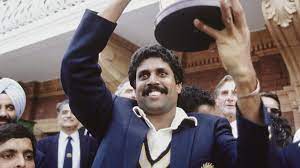
Kapil Dev is a name synonymous with cricket triumph across the globe. The Indian cricketer first began playing cricket for his state, Haryana, and quickly progressed to join the Indian cricket team in 1978. In 1983, as captain of the Indian national team, he almost single handedly led India to victory against Zimbabwe at the World Cup, with a record high of 175 runs. He has also received the Padma Shri and Padma Bhushan awards for his cricketing career, and in 2021, the film ‘83’ starring Ranveer Singh was released as a memoir of Kapil Dev’s iconic captaincy that led the struggling Indian team to victory in the World Cup. 

  1. Mahendra Singh Dhoni

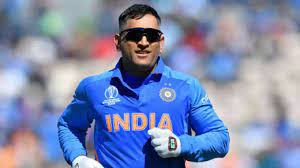
MS Dhoni is widely regarded as one of the best cricketers in India and the world, and his rise to international success is one of perseverance, commitment, and sheer hard work. Originally from Jharkhand, Dhoni began playing cricket in Ranchi and was soon scouted to participate in the tour of Bangladesh in 2004. Soon thereafter, he began displaying his prowess as a magnificent batsman, powerful pinch-hitter, and reliable wicketkeeper. Dhoni’s captaincy was no less inspirational, and he led India to a shocking victory on his first assignment at the World T20 in 2007, soon taking over the ODI leadership as well as Test cricket leadership. He also went on to lead Chennai Super Kings in the IPL, becoming a fan favorite and household name. His inspirational journey and story of fame from a young boy in Ranchi has also been captured in the 2016 film, ‘M.S. Dhoni: The Untold Story.’

  1. Ricky Ponting

Ricky Ponting was Australia’s premier batsman in the 1990s and is widely known as one of the greatest cricket captains of all time. The cricket prodigy scored four centuries in the Under-13 Tasmanian cricket week and by the time he was 20, he had debuted in international Test cricket. Over the years, he played a pivotal role in leading Australian cricket to new heights, in particular, leading the national team to victory against South Africa in the 2003 Cricket World Cup. 

Sources:

  1. https://www.britannica.com/biography/Kapil-Dev
  2. https://thevintagecricket.com/top-10-best-cricket-captain-in-the-world/
  3. https://www.cricbuzz.com/profiles/265/ms-dhoni
  4. https://www.britannica.com/biography/Ricky-Ponting

Blog 31 – The Grass Court Chronicles: Legends of Wimbledon

Wimbledon is a name synonymous with the sport of tennis, and the Wimbledon Championships is widely recognized as the oldest, and most prestigious, tennis tournament in the world; held at the All England Club in London each year since 1877. The tournament is the only one that is still played on natural grass courts, and is one of four annual ‘Grand Slam’ tennis events, along with the French, U.S., and Australian Opens. Tennis superstars have battled highs and lows at these Grand Slam tournaments over the years, yet the legends of Wimbledon remain as some of the most successful tennis athletes to go down in history, as the Wimbledon singles trophy remains the most coveted win. Let’s take a look at some tennis legends that have won The Championships not only once, but several times!

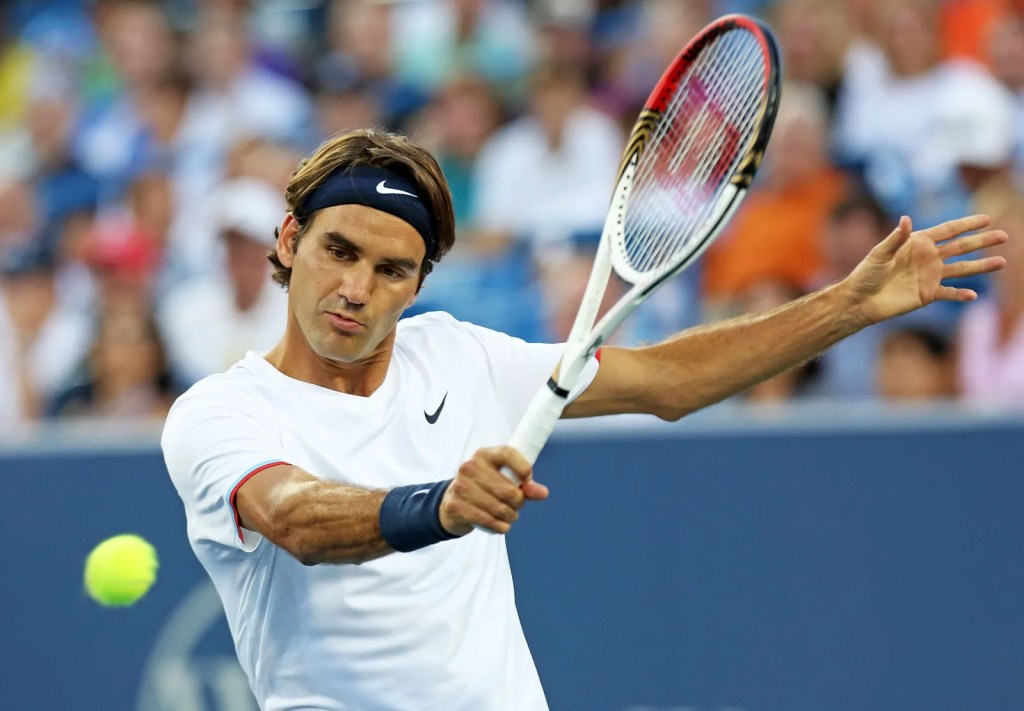
Roger Federer, the Swiss tennis icon, holds the record for winning the most Wimbledon titles, with his name etched on the trophy a total of eight times in the men’s singles event. From 2003 to 2007, serving up ace after ace, the Swiss legend won 5 consecutive men’s singles Wimbledon titles, surpassing the previous record holder, Björn Bjorg from Sweden, who had won four times in a row from 1976 to 1979. Bjorg was known for being the epitome of cool and calm on the tennis court, never revealing his emotions, and he rose to meteoric fame in his tennis career before shocking the world by announcing his retirement when he was only 26 years old. He dominated Wimbledon and his five-set marathon victory against John McEnroe in 1980 remains one of the most historic tennis matches ever played.

Following Federer’s unrivaled eight-time Wimbledon win, Pete Sampras and the beloved Novak Djokovic are tied, bagging seven Championship titles in their career so far. Sampras was no overnight success, but he made his mark in the tennis world when  he became the youngest US Open men’s singles champion at only 19 years old, defeating Andre Agassi in 1990. His Wimbledon wins are no small feat either, with seven titles in eight years, beginning with his victory in 1993. Djokovic is at par with Sampras with seven Wimbledon titles under his belt as well. He rose to fame when he beat Rafael Nadal in the 2011 Wimbledon Championship, and also beat Federer at the hallowed tournament thrice, in 2014, 2015, and 2019, causing great upset but also leading to him becoming a fan favorite and one of the top tennis players in the world. He is well on his way to beat Federer’s record of holding eight Wimbledon titles. 

Women at Wimbledon have also fared extremely well, but amongst them all, the Czech-American tennis champion, Martina Navratilova stands tall, with a record of nine Wimbledon women’s single titles under her belt between 1978 and 1990. Following closely are the American Williams sisters, with Serena Williams boasting seven women’s single wins between 2002 and 2016, and Venus Williams bagging five wins.  

Sources:

  1. https://olympics.com/en/news/most-wimbledon-titles-singles-tennis-winners-full-list
  2. https://www.tennisfame.com/hall-of-famers/inductees/bjorn-borg 
  3. https://olympics.com/en/news/novak-djokovic-numbers-records-stats-titles 
  4. https://www.tennisfame.com/hall-of-famers/inductees/pete-sampras 
  5. https://www.wimbledon.com/en_GB/players/overview/wta230220.html
  6. https://www.wimbledon.com/en_GB/players/overview/wta230234.html

Blog 30 – Breaking Barriers: Pioneering Moments for Women’s Cricket

Often known as the ‘gentleman’s game,’ cricket has traditionally been a sport associated with male players. However, women’s cricket has had a rich and varied history ever since its inception, and key pioneering moments in women’s cricket stand tall as testament to the glorious example of women smashing barriers to shine in their sport. An iconic moment that perfectly captures the essence of women breaking boundaries to excel at cricket is that of a charity cricket match in England in 1963 where men played against women. England Captain, Len Hutton said that the thought of women playing cricket was absolutely “absurd, like a man trying to knit.” The women’s team went on to win the match. So come, let’s take a look at some historic moments in women’s cricket!

Women have been playing cricket for nearly as long as men, with the first recorded match taking place between ‘eleven maids of Bramley and eleven maids of Hambledon in Surrey, England, in 1745. These village matches took place often, and a number of women’s clubs were formed, although the first official Women’s Cricket Association was established in Victoria in 1926, and brought with it the advent of national cricket tournaments for women in England. Prior to this, women’s cricket struggled to gain public acceptance and recognition, and was often played by women in secret, forming collegiate or post-work groups. However, the First World War played a role in bringing women out of hiding, and as their role in the public sphere grew, so did the nature of women’s cricket. It was no longer played in secret, but instead, women could be found playing cricket in the barracks, in training depots, military camps, and factory sites. The first match played by women on a first-class county ground was held at Worcester in 1932, following the establishment of the Women’s Cricket Association.

Another pioneering moment was the formation of the Australian Women’s Cricket Council (AWCC) in 1931, as this opened up the doors for the first global cricket tournament for women. The English women’s cricket team set sail for Australia, where they won two out of three test matches against the Australian team. Helen Elizabeth Archdale was a prominent feature at this time, as Captain of the England women’s cricket team who led the 1934-35 tour of Australia and New Zealand. She was a leading ambassador for women’s cricket as an active member of the Women’s Cricket Association (WCA) and helped popularize women’s cricket immensely. 

History was made when the first women’s Cricket World Cup took place in 1973, two years before the men’s World Cup. Businessman Jack Hayward financed the tournament and funded the 40,000 pound cost of bringing national women’s teams to England for the World Cup, including Australia, New Zealand, Trinidad & Tobago, Jamaica, Young England, and an International XI. England won the finals, beating Australia by 92 runs, and the experimental World Cup was deemed a success, encouraging the International Cricket Council (ICC) to host the men’s World Cup in 1975. 

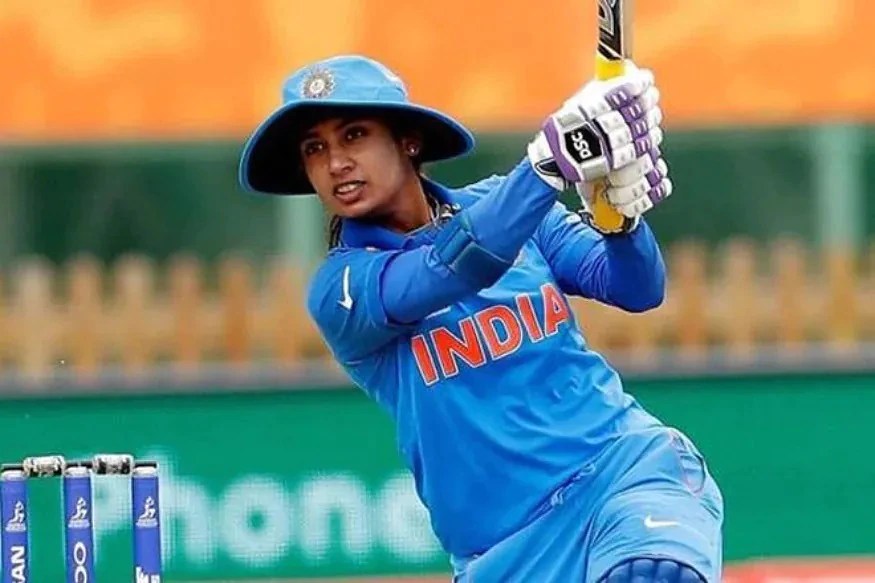
Ever since then, women’s cricket has received its much-deserved recognition and spotlight. Legendary women cricketers such as Belinda Clark, who scored the first ever double-century at the 1997 World Cup, Sajjida Shah, who hauled a record 7 wickets for 4 runs against Japan in 2003, and Mithali Raj, India’s team captain who led her team to victory in 100 international matches, have become household names today.

Sources:

  1. https://www.lords.org/lords/news-stories/women-s-cricket-evolution
  2. https://www.britannica.com/topic/Womens-Cricket-Association 
  3. https://femalecricket.com/women-cricket-news/24227-the-most-legendary-moments-in-womens-cricket.html 
  4. https://femalecricket.com/women-cricket-news/24227-the-most-legendary-moments-in-womens-cricket.html 

Blog 29 – The Next Generation: Rising Stars of the Tennis World

The realm of tennis stands as a vivid tapestry woven with intense competition, awe-inspiring athleticism, and unwavering dedication. With a heritage steeped in the exploits of legendary players, the sport’s enduring allure continues to captivate enthusiasts across the global stage. Yet, akin to the ebb and flow that graces every athletic pursuit, tennis too experiences transition. As the mantle gracefully transfers from one era to the next, an assembly of gifted and zealous contenders surfaces, poised to etch their indelible imprints on this hallowed discipline.

In the twilight of their illustrious careers, established tennis luminaries such as Rafael Nadal, Novak Djokovic, and Serena Williams guide the sport through an evolving metamorphosis. The torchbearers of tomorrow navigate the grandeur of premier tournaments, seizing the spotlight and beckoning the attention of ardent admirers. While witnessing a cherished tennis stalwart falter in the grand culmination of a Grand Slam finale — such as the poignant encounter where Federer narrowly yielded to Djokovic by a mere four points — there emerges a silver lining. This transformation ushers forth a fresh generation, exemplified by the ascent of Djokovic as a fervently embraced fan favorite.

Let us now cast our gaze upon the luminaries who promise to shape the panorama of rising tennis stars:

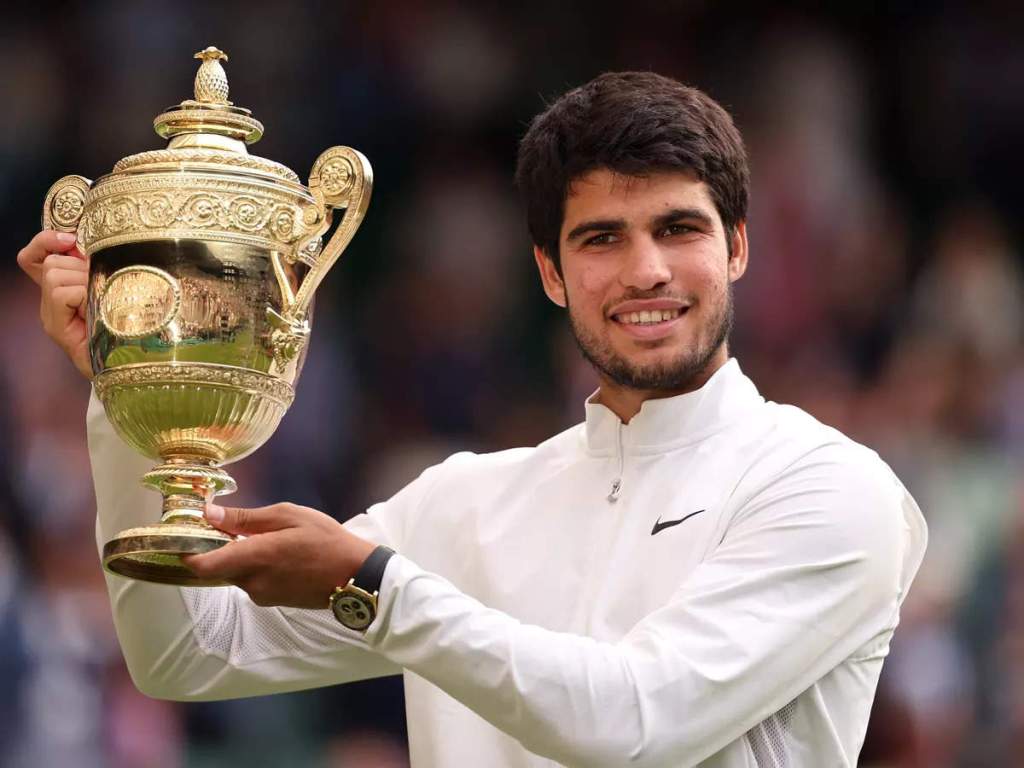
  1. Carlos Alcaraz: The resounding echoes of the 2023 Wimbledon Championship’s men’s singles final reverberate with the name Carlos Alcaraz. An unforgettable spectacle unfolded as the young Spanish prodigy toppled the reigning champion, Novak Djokovic, achieving a resplendent triumph and clinching the championship. This illustrious feat positions Alcaraz as a contender to etch his name among the ranks of revered tennis legends like Federer, Nadal, and Djokovic.
  1. Coco Gauff: The United States heralds the emergence of a potent force in the form of Coco Gauff. A breathtaking victory over the illustrious Venus Williams during Wimbledon’s 2019 edition thrust Gauff into the spotlight when she was a mere 15 years of age. Her dynamic on-court presence, unyielding poise, and an arsenal of skills make her a formidable contender. Gauff’s steadfast consistency has propelled her into the upper echelons of global female tennis rankings, foreshadowing an impending era marked by triumphant achievements.
  1. Felix Auger-Aliassime: Canada bequeaths to tennis enthusiasts the charismatic and explosively skilled Felix Auger-Aliassime. Armed with a potent serve and a multifaceted game, he commands attention as a luminary in the making. Several ATP titles and a rapid ascent through rankings mark Auger-Aliassime as a name destined for illustrious heights within men’s tennis.
  1. Jannik Sinner: From the heart of Italy emerges a tennis prodigy known as Jannik Sinner, whose meteoric rise through the echelons has captured the imagination of aficionados. Displaying a finesse reminiscent of tennis legends, his strokes resonate with technical brilliance. Armed with an astute tactical acumen and mental fortitude beyond his years, Sinner’s victory at the Next Gen ATP Finals serves as a prelude to his dominion over elite competitions.
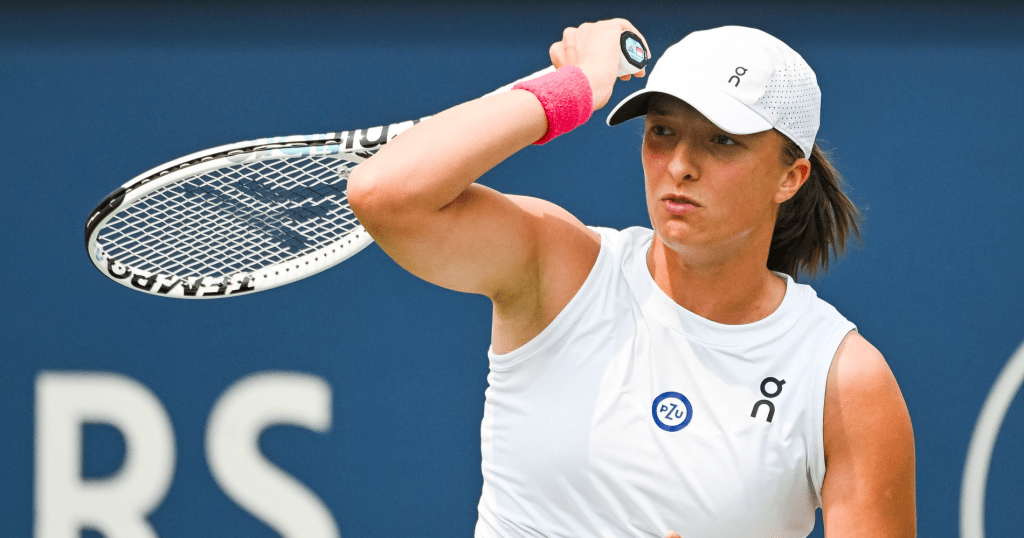
  1. Iga Swiatek: The resplendent victory of Poland’s Iga Swiatek in the 2020 French Open reflects the dawn of a new era. Her assertive baseline prowess and unflinching poise under pressure distinguish her in the intensely competitive women’s domain. As Swiatek’s skills mature, her ascent instills hope for a sustained presence on the grand stages of tennis’s most formidable challenges.

The rise of these luminaries stands as a testament to the sport’s enduring charisma. Their narratives are etched with sacrifice, resilience, and an unwavering commitment to transcendence. As these youthful virtuosos refine their artistry, the tennis community eagerly anticipates electrifying rivalries, captivating showdowns, and moments of historical significance that shall inscribe their names onto the grand tapestry of tennis lore. Beyond their athletic prowess, these emerging stars inspire a burgeoning generation of tennis aficionados. Their stories of tenacity, unwavering spirit, and relentless pursuit of greatness serve as beacons of aspiration for young athletes yearning to follow in their footsteps. A surge in participation in tennis academies, grassroots initiatives, and junior competitions heralds an era where enthusiasts aspire to emulate these icons and carve their own paths towards magnificence.

Sources:

  1. https://sportstar.thehindu.com/tennis/roger-federer-retires-grand-slam-finals-record-11-losses-nadal-djokovic-del-potro/article65896456.ece 
  2. https://www.hindustantimes.com/sports/tennis/watch-novak-djokovic-left-crestfallen-breaks-into-tears-calling-carlos-alcaraz-wimbledon-loss-roger-federer-revenge-101689531832290.html
  3. https://www.tennis-prose.com/articles/rising-stars-of-tennis-exploring-the-next-generation/
  4. https://www.sportskeeda.com/player/iga-swiatek
  5. https://www.atptour.com/en/players/felix-auger-aliassime/ag37/overview
  6. https://www.usopen.org/en_US/players/overview/wta328560.html 

Blog 28 – Cricket’s Finest All-Rounders: Masters of Bat and Ball

The mysterious figures known as all-rounders emerge as the personification of exceptional talent and limitless variety in the mesmerising world of cricket, where the bat and ball dance in a symphony of athletic prowess. They master the complex skill of bowling, the pure grace of batting, and the quick dexterity of fielding with ease, dominating various facets of the game. Similar to heavenly constellations, these extraordinary athletes provide their teams priceless contributions that resonate in the echoes of resounding victories and nerve-wracking willpower contests.

Their impressive hold over the knowledge of both batting and bowling – the cornerstones of the sport, is on display in cricket, which is a thrilling, eye-catching sport that functions by virtue of the outstanding abilities of its all-rounders – its pillars. These extraordinary artists have the rare ability to make a strongfelt impact on their team’s victories, handling deftly the weather, the tether, the leather, and the willow. The best all-rounders in this game, hence, shall be looked further into, in this essay as we explore what it is that makes them the virtuosos that they are and what sets them apart from their contemporaries which might have achieved mastery, just not quite what is considered masterful. 

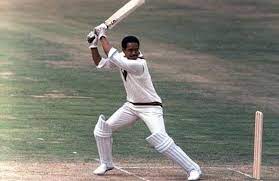
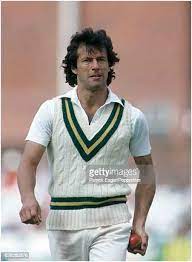
A pantheon of famous all-rounders who have left their indelible marks on the very foundation of the game of cricket are entombed inside the pages of the sport’s history. Sir Garfield Sobers, Ian Botham, Imran Khan, Kapil Dev, and Jacques Kallis stand out as the pinnacle of all-around talent among the select few. A gorgeous colossus from the Caribbean named Sir Garfield Sobers transcends brilliance and leaves a lasting legacy. In the rich fabric of English cricket history, Ian Botham, the forerunner of batting explosions and the master of mesmerising swing bowling, gains legendary status. The pinnacle of technical skill, Jacques Kallis, cements his place in cricket lore by using his bat as a tool to score runs and his bowling arm to deliver pinpoint accuracy.

Sir Gary Sobers

A true all-rounder has nothing short of seismic effects on the overall picture of a cricket match. With their razor-sharp bowling, these amazing players snare a flurry of important wickets while simultaneously dumping an avalanche of runs onto their team’s scoreboard with their awe-inspiring batting performances. All-rounders have the uncanny capacity to change the course of a game thanks to their chameleonic abilities, sparking triumphant moments with their game-winning performances. Their diverse contributions provide teams with a kaleidoscope of strategies, bringing balance and a wide range of tactical options.

Imran Khan

All-rounders are like shooting stars in the cricketing sky because of their amazing skill sets and unrestricted mobility. They distinguish themselves apart from their contemporaries. Their skill set includes the magic of technically flawless batting, the artistry of unflinching control in bowling, and a unique sense to negotiate the perilous terrain of constantly shifting game conditions. In order to maintain cool in the face of pressure and to exhibit unflinching consistency throughout the broad pantheon of game formats, all-rounders display mental fortitude, a steadfast friend. Like expert chess players moving their pieces on the grand board, their keen cricketing insight enables them to coordinate wise selections and smoothly fill crucial spots in both the batting and bowling lines.

Ben Stokes, Shakib Al Hasan, and Ravindra Jadeja have all become icons of all-around greatness in the modern era of cricket. With his herculean efforts for England, particularly his epochal innings in the 2019 Cricket World Cup final, Ben Stokes, a personification of contemporary splendour, has cemented his place in sporting mythology. Shakib Al Hasan, the mysterious master from Bangladesh, is a force unto himself and uses bat and ball to create his tapestry of contributions. With his daring batting approach and alluring left-arm spin, Ravindra Jadeja has established himself as an essential component of India’s potent armory and a dazzling diamond in the crown.

Ben Stokes

The names of cricket’s finest all-rounders have been recorded on the holy scrolls of the game’s past for all time, providing inspiration for future generations. They take the sport to new heights with their remarkable skills and match-winning feats, captivating spectators with their kaleidoscopic versatility and undeniable talent. Future generations of players who aspire to emulate their celestial accomplishments and embody the essence of the all-rounder within the grand tapestry of cricket’s alluring mystery will find endless inspiration from these bat-wielding and ball-wielding virtuosos’ legacy, an eternal flame burning bright, which will continue to illuminate the cricketing cosmos.

Sources: 

  1. https://www.kreedon.com/best-all-rounder-in-the-world/
  2. https://blog.mansion.com/sports/cricket/crickets-5-greatest-all-rounders/
  3. https://bleacherreport.com/articles/1876451-xi-picking-a-team-of-crickets-greatest-all-rounders

Blog 27 – The Clay Court Maestros: Masters of the Red Dirt

The versatile sport of tennis can be played on a number of surfaces, ranging from grass courts to hard courts, and clay courts. Clay courts primarily consist of two types — red clay courts like the ones in the French Open, that are made of crushed brick, and green clay courts or Har-Tru that include crushed metabasalt topped off with green clay. Each tennis surface demands a different skill and playing strategy from athletes, and due to their hard, bouncy nature, clay courts tend to enable balls to bounce for longer, making it difficult to hit quick wins. As a result, rallies tend to last longer on clay courts as compared to grass courts, and they demand greater stamina and endurance from players. 

Let’s take a look at some of the clay court maestros in history:

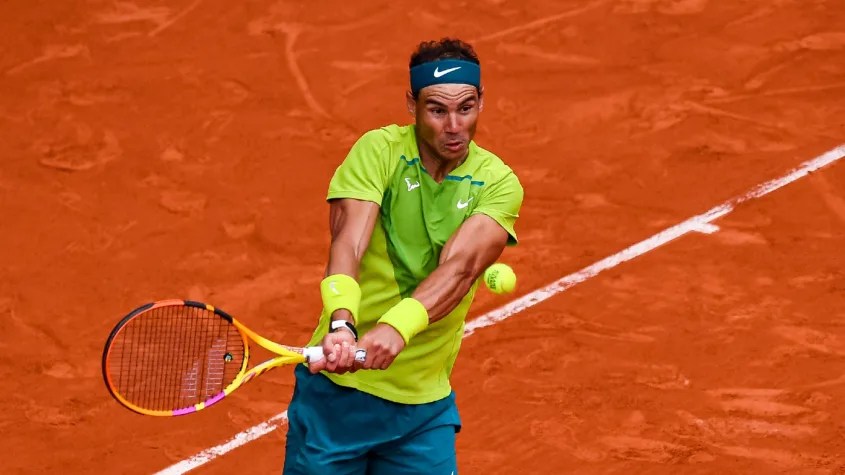
  1. Rafael Nadal (Spain): Commonly known as the King of Clay, Rafael Nadal is a name synonymous with tennis. The Spanish player, fondly called Rafa, has a record-breaking career consisting of 14 French Open titles and 22 Grand Slam men’s single titles. Nadal grew up in a sports-centric family, and began playing tennis at the mere age of four. Following his first professional match in 2001, he quickly climbed up the ranks, with a near unbeatable record, rivaled only by world number one Roger Federer.
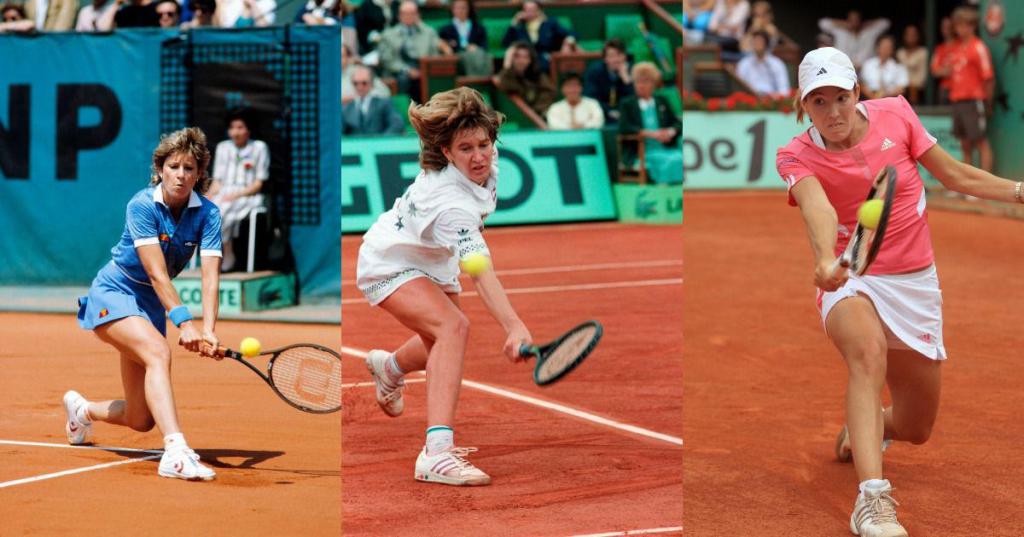
  1. Chris Evert (U.S.): Chris Evert surpassed most of her male counterparts when it came to tennis on the clay court, winning seven French Open titles, and coming second only to Rafael Nadal. Her beauty and grace while playing the sport was unmatched, and reflected her tireless practice since the age of five. Commonly known as America’s tennis sweetheart, she quickly became a household name attached to the game of tennis.
  1. Björn Borg (Sweden): Björn Borg is a retired Swedish tennis player who won the Wimbledon championship five times in a row, and also proceeded to win every French Open final that he played in. The Swede began playing tennis at a young age, and by the time he was 13 years old, he was better than most of Sweden’s top junior professional players.
  1. Justine Henin (Belgium): Justine Henin is widely regarded as one of the most unstoppable female tennis players when it comes to playing on clay courts, setting a record at the French Open by winning 35 sets in a row. Her powerful serve and backhand were her trademark moves, and she surprised the world by announcing her retirement in 2008 while she was at the top of her game. However, she returned to play competitively in 2010, placing second at the Australian Open.

These are just a few of the maestros of the clay court, and are all professional athletes at the top of their game whose name is synonymous with the sport of tennis. Their endurance, hard work, and skill on the often unforgiving clay court remains unparalleled and they stand tall as champions in the International Tennis Hall of Fame. 

Sources:

  1. https://www.masterclass.com/articles/types-of-tennis-courts
  2. https://olympics.com/en/news/tennis-court-markings-dimensions-size-types-variety-surface-hard-grass-clay 
  3. https://bleacherreport.com/articles/1347476-greatest-clay-court-players-in-tennis-history 
  4. https://www.tennisfame.com/hall-of-famers/inductees/chris-evert 
  5. ​​https://www.britannica.com/biography/Rafael-Nadal 
  6. https://bleacherreport.com/articles/1347476-greatest-clay-court-players-in-tennis-history 

Blog 26 – Cricketers in Film and Politics

Cricketers have always been regarded as heroes in India. They are worshipped and celebrated by fans across the country. But in recent years, a growing number of cricketers have ventured into different fields, such as film and politics. Let’s take a look at some of the cricketers who have made a name for themselves in these industries.

Film:

The world of cinema has always been attractive to cricketers. Some have even tried their hand at acting. One of the most successful cricketers-turned-actors is the legendary Sunil Gavaskar. He made his acting debut in the Marathi film ‘Savli Premachi’ in 1980. Although he only acted in a few films, his performances were appreciated by the audience. Gavaskar also made a cameo appearance in the film ‘Maalamal’ in 1988.

Another cricketer who made a foray into acting is Vinod Kambli. He starred in the Marathi film ‘Annabhau Sathe’ in 2012. However, the film failed to make an impact at the box office.

However, the most successful cricketer-turned-actor is undoubtedly Sandeep Patil. He appeared in the film ‘Kabhi Ajnabi The’ in 1985 and went on to act in several Hindi, Marathi, and Kannada films. Patil’s most notable performance was in the Marathi film ‘Sinhagad’ in 1996, which was a box office success.

Politics:

Cricket and politics have a long-standing connection in India. Many cricketers have taken the plunge into politics and have successfully transitioned from the cricket field to the political arena. One of the most successful cricketers-turned-politicians is Navjot Singh Sidhu. He was a member of the Indian cricket team from 1983 to 1999 and then transitioned to politics in 2004. Sidhu was a member of the Bharatiya Janata Party (BJP) and was elected to the Lok Sabha in 2004. He later joined the Indian National Congress in 2017 and was appointed as the Minister of Local Government, Tourism, and Cultural Affairs in the Punjab government.

Another cricketer who has found success in politics is Kirti Azad. He was a member of the Indian cricket team from 1980 to 1986 and then joined the BJP. Azad was elected to the Lok Sabha in 1999 and served as a Member of Parliament for three terms. He is known for his work in promoting sports and was the Chairman of the Delhi District Cricket Association.

Mohammad Azharuddin, who was the captain of the Indian cricket team from 1989 to 1999, also entered politics. He joined the Congress party in 2009 and was elected to the Lok Sabha in 2009 and 2014. However, his political career was marred by controversy, and he was suspended from the Congress party in 2019.

Apart from these cricketers, there are several others who have entered politics, such as Chetan Chauhan, Gautam Gambhir, and Sachin Tendulkar. While Tendulkar has not contested any elections, he was nominated to the Rajya Sabha in 2012 and served as a Member of Parliament for six years. Cricketers are among the most popular figures in India, and it’s no surprise that many of them have tried their hand at different fields. While some have succeeded, others have failed. However, the fact that they are able to venture into different industries and make a name for themselves is a testament to their versatility and determination.

Despite the success of some cricketers in films and politics, there are those who believe that they should stick to what they do best – playing cricket. Critics argue that cricketers are role models and that their involvement in other fields might distract them from their primary responsibilities. They also argue that their fame and popularity could be used to promote the sport and not for personal gain.

However, others believe that cricketers have the right to pursue their passions outside of cricket. They argue that these ventures can help cricketers develop new skills and broaden their horizons. Additionally, cricketers who enter politics can use their platform to bring attention to important issues and make a positive impact on society.

In conclusion, cricketers in India have been successful in making a name for themselves in different fields, including film and politics. While some have been more successful than others, their ventures into these industries show their versatility and determination. While there may be those who criticize their involvement in other fields, it is ultimately up to each individual cricketer to decide how they want to use their platform and pursue their passions. Regardless of their choices, they will always be celebrated and admired by fans across the country for their contributions to the sport of cricket.

Sources: 

  1. https://timesofindia.indiatimes.com/blogs/O-zone/cricket-bollywood-politics/
  2. https://www.pinkvilla.com/entertainment/news/kapil-dev-to-yuvraj-singh-7-indian-cricketers-who-have-acted-in-films-1194682
  3. https://indianexpress.com/photos/sports-gallery/ten-indian-cricketers-who-turned-into-politicians-7206331/

Blog 25 – The Rite of Racquet Passage: Steps To Tennis Glory 

Tennis is a game of skill, determination, and hard work. It requires discipline, practice, and a deep understanding of the game. But beyond these basic requirements, there are certain rites of passage that every aspiring tennis player must go through in order to achieve success on the court. From mastering the basic strokes to developing a winning mentality, the path to tennis glory is paved with challenges and opportunities for growth.

The first step on the path to tennis glory is mastering the basic strokes. Tennis requires a complex set of skills, including forehand, backhand, serve, and volley. Each of these strokes requires a different technique and a different level of skill, and mastering them is essential for success on the court. The forehand and backhand are the foundation of the game, and players must spend hours practicing their technique in order to develop the consistency and power needed to compete at a high level. The serve is also critical, as it sets the tone for the match and can give players a significant advantage if executed correctly. The volley is the final piece of the puzzle, and mastering this stroke requires a combination of reflexes, footwork, and strategy.

Once a player has mastered the basic strokes, the next step is to develop a winning mentality. Tennis is a mental game as much as a physical one, and players must learn to deal with the pressure and uncertainty of competition. This requires a combination of confidence, focus, and mental toughness. Players must be able to maintain their concentration throughout the match, and to stay focused even in the face of adversity. They must also be able to handle the pressure of important points and maintain their composure in high-stress situations. Developing a winning mentality takes time and practice, but it is essential for success in the game of tennis.

Another important rite of passage in the world of tennis is the transition from junior to professional play. Many talented young players dream of becoming professional tennis players, but the transition from junior to professional play is not easy. It requires a combination of physical and mental preparation, as well as a deep understanding of the game and the challenges of competition at the highest level. Players must be able to compete with older, more experienced opponents, and must be able to handle the physical demands of professional play. They must also be able to navigate the complex world of professional tennis, with its many tournaments, rankings, and rules.

Beyond these basic rites of passage, there are many other challenges and opportunities for growth on the path to tennis glory. Players must learn to adapt to different playing styles and court surfaces, and to develop a strategic approach to the game that takes into account their strengths and weaknesses. They must also learn to work with coaches and trainers, and to develop a support network of family, friends, and fans who can help them through the ups and downs of the game.

Ultimately, the path to tennis glory is a journey of self-discovery and growth. It requires discipline, dedication, and a deep passion for the game. It also requires a willingness to face challenges and to embrace opportunities for growth and development. From mastering the basic strokes to developing a winning mentality, and from the transition to professional play to the ongoing challenges of competition at the highest level, the rite of racquet passage is a journey that demands the best of every player.

Tennis is a game of skill, determination, and hard work, and the path to tennis glory is paved with challenges and opportunities for growth. From mastering the basic strokes to developing a winning mentality, and from the transition to professional play to the ongoing challenges of competition at the highest level, the rite of racquet passage is a journey that demands the best of every player. But for those who are willing to embrace the journey and to rise to the challenges it presents, the rewards can be great: the thrill of victory, the satisfaction of a hard-fought match, and the knowledge that they have given their all in pursuit of their dreams. So, if you are an aspiring tennis player, embrace the rite of racquet passage, and enjoy the journey. Who knows where it may take you?

Sources: 

  1. https://benryan.co.uk/the-fed-express-beyond-perfect/
  2. https://www.ncbi.nlm.nih.gov/pmc/articles/PMC2577481/
  3. https://www.kreedon.com/how-to-serve-in-tennis-learn-in-5-steps/?amp=1
  4. https://www.head.com/de_AT/tennis/how-tos/how-to-choose-a-tennis-racquet-in-10-steps