

All sports have specialized vocabulary that they use to express the nuances of the regulations and the flow of play. However, the grading is typically at least predictable and easy to understand. With tennis, however, the case is different.
For those who are new, tennis begins with both players at 0, or “love-all.” Score for one person: 15 for love. The server’s score is announced first, followed by the receiver’s. They are now tied at “15-all” after the other scores. The following point scores the game-winning goal at 30, then 40. A deuce is called if they tie after 40 points. From there, the next player to score has the advantage. However, in most cases, to win the game, the player must score twice in a row and win by a margin of two points. And that’s not the end of it. A set is made up of six of these games, and a set must be won by two games in order to avoid a tiebreaker.
It then repeats after the set is over. Depending on the event, winning the best of five sets or the best of three sets is required to win the entire match.
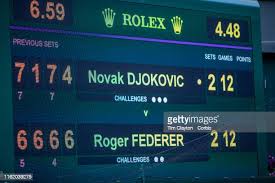
This system of scoring is often considered to be peculiar and odd and fans have often wondered about the need for keeping such a quirky system of scoring. Not to disappoint the fans and the curious reader, pretty much every part of this system is a mystery, leaving people to speculate what started where.
According to Elizabeth Wilson, a writer, “there are many theories, and numerous romantic conceptions have been developed concerning it. Tennis has a lot of history that isn’t really history; it’s more legend than actual history, which is in part what turns tennis into a sort of romantic game. Some of the theories as to how it got started are rather fantastical.”
The tennis scoring system has remained consistent since the Victorian era, despite its intricacy. The origins of the contemporary game of tennis can be found in the 12th century French game known as jeu de paume. In the beginning, the palm of the hand was used to play; by the sixteenth century, rackets had been introduced. Wilson claims that tennis was highly stylized from the start because of its close ties to the pageant traditions of the French court.
Records of scoring systems similar to the ones used today stretch back practically to the start of the sport, however throughout these years, the scoring was done with increments of 15, 30, and 45 points, which at least makes more sense mathematically than the current system. Several years after the Battle of Agincourt in 1415, a poem was composed that counts up the points—15, 30, and 45—in a tennis match between English King Henry V and the French Dauphin.
There are several theories as to where the English word tennis came from, although it undoubtedly appeared in the 15th century.) For instance, Jan van den Berghe raised concerns about how players could score fifteen points with a single stroke in the 1520s. The fact that they count or award more than one point for a single stroke is, after all, a little odd. Why aren’t one and two points awarded for a single and double stroke, respectively?
The history of scoring systems in other games, sophisticated multiplication, measurements of the separations between lines of demarcation on early courts, and other factors have all been used in numerous ideas throughout the years, but no conclusive solution could be established.
Sources:
- https://thetennisbros.com/tennis-tips/rules/why-is-tennis-scored-the-way-it-is/
- https://www.sportingnews.com/us/tennis/news/tennis-scoring-explained-rules-system-points-terms/7uzp2evdhbd11obdd59p3p1cx
- https://www.theguardian.com/notesandqueries/query/0,5753,-20405,00.html
- https://improves.co/tennis-scoring-system/

 10 Reasons Why the Cookie Crumbled the Way It Did